
Armenia’s Prime Minister, Nikol Pashinyan, has been at the centre of the country’s most momentous events in the 21st century. In 2018, he functioned as the figurehead of the Velvet Revolution, a series of pro-Democracy protests which saw the peaceful ouster of long-time president (and, according to some, would-be strongman) Serzh Sargsyan.
While Pashinyan was initially popular, hailed as a democratic reformist against an oligarchic and authoritarian status-quo, his reputation has taken a beating due to events out of his control. In 2020, Azerbaijan launched an offensive to retake Nagorno-Karabakh, an area between Azerbaijan and Armenia that the two countries fought over bitterly during the dissolution of the Soviet Union between 1988-1994. Over the course of the war, known as the First Nagorno-Karabakh War, both sides committed atrocities and ethnic cleansing. The war ultimately ended in an uneasy stalemate: Nagorno-Karabakh (known as Artsakh in Armenian and Qarabağ in Azeri) remained in de facto Armenian control with a majority Armenian population, while it remained de jure a part of Azerbaijan under international law.
Faced with military defeat, over a hundred thousand refugees on Armenian soil, an ailing economy and popular outrage at a widely unpopular peace deal, Pashinyan is now facing the greatest challenge of his career.
In 2020 Azerbaijan launched the Second Nagorno-Karabakh War, and in less than two months managed to wrest Nagorno-Karabakh from Armenia. This was enabled in large part by Turkish military support for Baku in the form of drones and fighter jets lent by Ankara, as well as oil-rich Azerbaijan’s long-term investment into Russian military hardware. As an uneasy ceasefire and prolonged peace negotiations settled in, Azerbaijan declared a blockade on Nagorno-Karabakh in December 2022, and by October 2023 over 100,000 of the region’s 120,000 people had fled to Armenia as refugees.
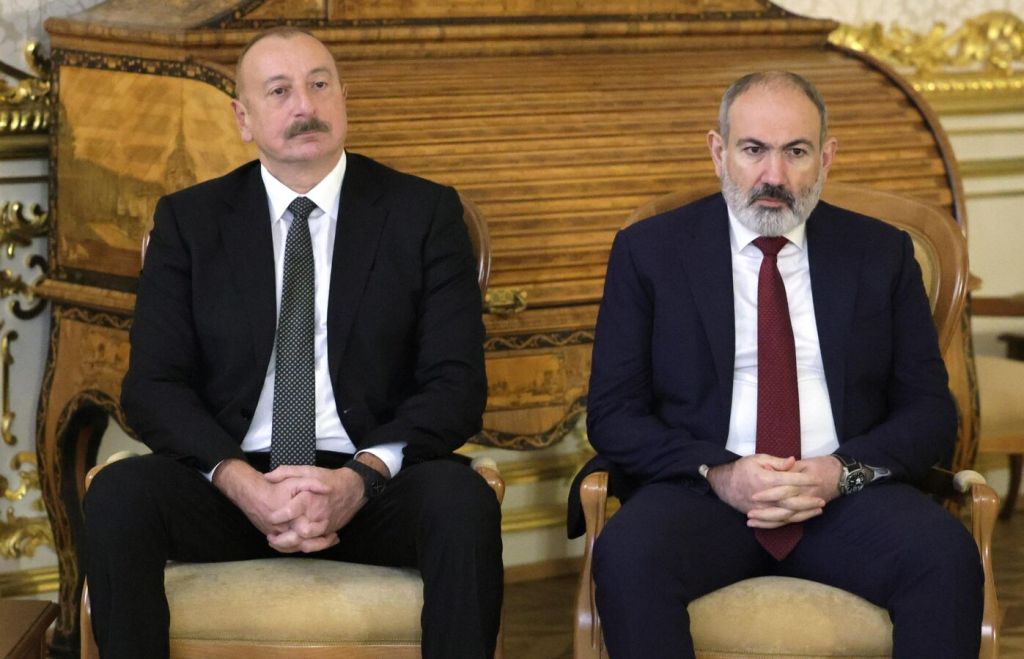
İlham Aliyev, President of Azerbaijan (left) and Nikol Pashinyan, Prime Minister of Armenia, at the Commonwealth of Independent States (CIS) meeting in St. Petersburg, Russia, December 26, 2023. Commonwealth of Independent States
Faced with military defeat, over a hundred thousand refugees on Armenian soil, an ailing economy and popular outrage at a widely unpopular peace deal, Pashinyan is now facing the greatest challenge of his career. In order to reverse his and Armenia’s fortunes, he is looking to turn Armenia’s regional alignments and geopolitical strategy on its head.
Enemies old and new
Turks and Azeris1 are closely related to each other: Azeri and Turkish are, to a great extent, mutually intelligible: anyone who has travelled across Anatolia can attest that the more East one travels, the more local dialects start to resemble Azeri in a neat gradient. A common Pan-Turkist nationalist slogan in both countries is tek millet, iki devlet – ‘one nation, two states’.
Armenia has historically sought to protect itself and gain access to global markets by aligning with Russia, the region’s former imperial overlord. But in recent years, Russian hegemony has waned as the war in Ukraine has consumed Russia’s resources and focus.
Turkey, Armenia’s largest and wealthiest neighbour, issued a still-in-place blockade against Armenia during the First Nagorno-Karabakh War, isolating and impoverishing Armenia. Azeris are often called ‘Turks’ by Armenians, and the scenes of tens of thousands of Armenian refugees fleeing Azeri troops triggered collective memories of the 1915-1918 Armenian Genocide in the Ottoman Empire, as well as memories of ethnic massacres and fighting between Azeris and Armenians in the same time period.
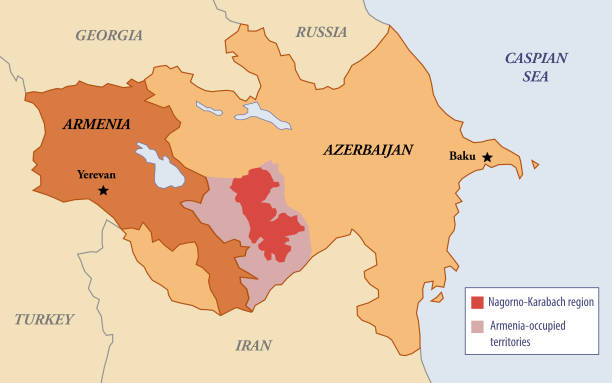
The Nagorno-Karabakh region between Armenia and Azerbaijan. Getty Images/Dimitrios Karamitros
Being effectively blockaded by two of its four neighbours, Armenia has historically sought to protect itself and gain access to global markets by aligning with Russia, the region’s former imperial overlord. But in recent years, Russian hegemony has waned as the war in Ukraine has consumed Russia’s resources and focus: Armenians were outraged that Azerbaijan’s 2020 offensive was carried out with arms purchased from Russia, and that Russia refused to rein in Azerbaijani aggression as it had done before.
Anti-Russian sentiment, already growing in the run-up to Serzh Sargasyan’s ouster, has reached a fever pitch, with demonstrations outside the Russian embassy in Yerevan and petty insults traded between Armenian and Russian officials.
This Russian ‘betrayal’ was only made worse by the fact that Armenia is a member of the Collective Security Treaty Organization (CSTO), Russia’s answer to NATO made up of post-Soviet states. Similar to NATO, Article 4 of the CSTO treats aggression against one member as aggression against all. Armenia is a member, Azerbaijan isn’t, but Russia and other CSTO members have refused to substantially aid Armenia despite Armenia’s triggering of Article 4 in 2022 when Azerbaijani troops entered Armenian territory. Russian troops were meant to act as peacekeepers, yet Azerbaijan was able to blockade Nagorno-Karabakh with impunity. Anti-Russian sentiment, already growing in the run-up to Serzh Sargasyan’s ouster, has reached a fever pitch, with demonstrations outside the Russian embassy in Yerevan and petty insults traded between Armenian and Russian officials.
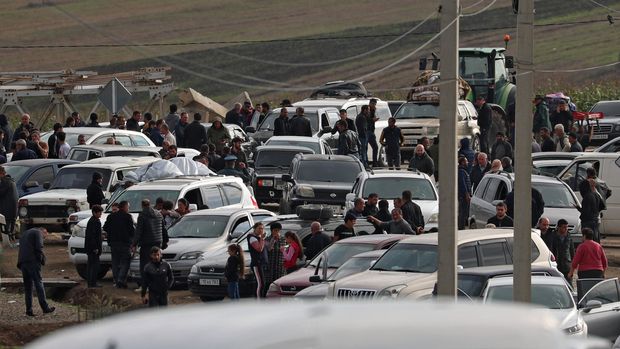
Ethnic Armenians fleeing Nagorno-Karabakh. REUTERS/Irakli Gedenidze
Pashinyan’s Big Gambit
Pashinyan’s big plan is rooted in a sober reading of Armenia’s geopolitical position: the country has been militarily outgunned by Azerbaijan, economically blockaded by Turkey, and politically abandoned by Moscow. In order to break Armenia’s isolation, Pashinyan is betting big on three things: 1) a peace deal with Azerbaijan that gives the country breathing space, 2) negotiations with Turkey to normalise relations and open borders, and 3) pivot to the US and Europe, rather than Russia, for protection. Each one of these comes with its own set of problems and risks.
1. Peace with Azerbaijan
As part of the peace talks with Azerbaijan, in April Armenia ceded control over four villages in de jure Azerbaijani territory it captured in the 1990s. Pashinyan had already stated that he is willing to recognise Nagorno-Karabakh as part of Azerbaijan, triggering outrage in Armenia. Domestically Pashinyan is facing a protest movement, led by Archbishop Bagrat Galstanyan, who has for months brought thousands of people onto the streets of Yerevan, demanding that Pashinyan and the government resign. While the demonstrations are starting to lose steam, the fact remains that any peace deal with Azerbaijan will remain extremely contentious at home: In 2021 Pashinyan claimed that there plans were afoot for a military coup against him.
Azerbaijan’s leader, İlham Aliyev, is in no rush. In the wake of Russia’s invasion of Ukraine, European demand and dependence on Azerbaijani oil and gas has soared, as have oil and gas prices.
Top-secret negotiations have dragged on, and little is known about their details. What is known is that Azerbaijan is demanding some form of access to the Zangezur Corridor that crosses Armenia’s border with Iran, allowing direct access between metropolitan Azerbaijan and the Azerbaijani exclave of Nakhchivan between Armenia and Turkey (and ultimately created a land bridge between Baku and Ankara). How this will be arranged in practice will be highly contentious.
Azerbaijan’s leader, İlham Aliyev, is in no rush. Ever since Russia’s invasion of Ukraine, European demand for Azerbaijani oil and gas has soared, as have oil and gas prices. Azerbaijan controls the situation on the ground, even more so after Russian peacekeepers departed in April. This confidence is evidenced by the fact that in addition to demanding access to the Zangezur Corridor, itself a big ask, in July Aliyev stated that his two major preconditions for peace are 1) amending the Armenian constitution to remove references to Nagorno-Karabakh as Armenian, and 2) dissolve the OSCE Minsk Group, tasked with negotiating a peaceful solution to the Nagorno-Karabakh conflict.
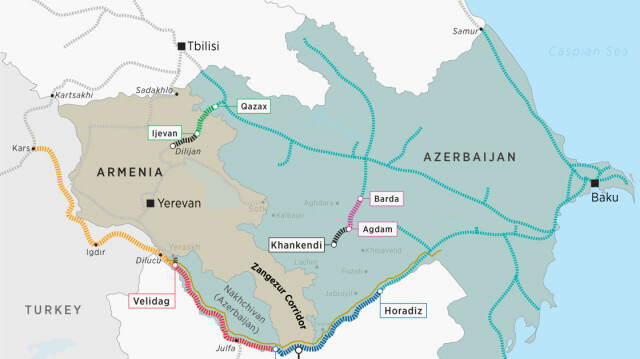
Potential rail link through the Zangezur Corridor to connect metropolitan Azerbaijan, the Azerbaijani exclave of Nakhchivan, and Turkey. Anadolu Ajansı
Peace talks have remained more or less static since December 2023, signalling that Aliyev is keen to wait and see what happens, especially with US elections in the horizon. For Pashinyan, pushing controversial concessions through to placate an intrasigent negotiating partner against a backdrop of domestic unrest will be more than an uphill battle.
2. Normalising ties with Turkey
If normalisation between Turkey and Armenia does play out, Turkish companies could earn billions of dollars from construction and infrastructure projects in Armenia and on infrastrucure between it and Azerbaijan while garnering favour with the West. Armenia, in turn, would benefit from Turkish investment, as well as access to its largest neighbouring market. Pashinyan has insisted that peace with Azerbaijan and normalisation with Turkey are taking place on two different tracks: in practice, this is unlikely to be the case. As peace negotiations have stalled, so have normalisation talks with Turkey.

Azerbaijani soldier inspecting the ruins of Cebrayil, an Azeri village emptied during the First Nagorno-Karabakh War, in April 2023. Reuters
While international commentators have vaunted the benefits of normalisation with Armenia, there is little incentive for Turkey to actively pursue it as a goal, since it has already achieved its aims. It has flexed its muscles by militarily supporting its ally, demonstrating the battlefield use of Turkish-manufactured drones. Turkish businesses will surely benefit from whatever concessions Azerbaijan can extract, and Armenia’s GDP is roughly that of the Turkish city of Bursa: it is hardly a grand prize.
Turkey might be seeking to increase its economic and political clout in the region at the expense of Russia, but its unlikely that this is part of any long-term grand strategy. Turkey’s military foreign policy tends to be either opportunistic, as was the case when Turkey supported the Libyan government in Tripoli against warlord Khalifa Haftar in 2020 in exchange for Tripoli recognising Turkey’s maritime claims in the Mediterranean, or based on the aim of eliminating Kurdish independence movements, as it is in Syria and Northern Iraq. It is likely that Turkey’s support for Azerbaijan is opportunism, buoyed by rising nationalist and Pan-Turkic sentiments at home.
While international commentators have vaunted the benefits of normalisation with Armenia, there is little incentive for Turkey to actively pursue it as a goal, since it has already achieved its aims.
Ultimately, Turkey will win whatever happens to Armenia: either a) its ally Azerbaijan strengthens its position in the region, b) Turkey exacts concessions from the West or Russia as part of back-room negotiations, or c) Turkey gains access to Armenian markets and hopefully Western goodwill. Erdoğan, like Aliyev, can bide his time.
3. Securing US and Western support
The most concrete changes Pashinyan has managed to make so far are on Armenia’s foreign policy posture: much to the chagrin of Moscow, Armenia has deepened its cooperation with the US and EU. Just this week the US hosted a joint military excercise with Armenian troops, and US Secretary of State Antony Blinken has taken an active role in facilitating peace talks. US policymakers seems to be especially keen on Armenia’s talk of an ‘East-West Corridor’ of opening up the whole country for cross-border trade and travel with all its neighbours in lieu of Azerbaijan’s (and Turkey’s) calls for the Zangezur Corridor. However, despite US backing, peace talks have stalled, and the Zangezur Corridor remains Aliyev’s outcome of choice.
While the US and EU have been encouraging towards Armenia, eager to pivot the country away from Russia’s sphere of influence, it is doubtful whether they would be willing to military support Armenia in a meaningful way, as they have much less to gain than Azerbaijan and Turkey, and are equally keen on keeping Azerbaijani oil flowing into Europe.
Out of EU actors, France has been the most vocal on Nagorno-Karabkh, withy French politicians actively highlighting the plight of civilians in the area and France being a negotiating partner in OSCE, which Aliyev wants dissolved. France’s sale of howitzers to Armenia has incenced Azerbaijan and hardened their negotiation stance, while being hardly enough to make a difference on the ground. US involvement has seemed to make little difference to either Azerbaijani or Turkish negotiators.

Pashinyan at a CSTO meeting in January 2022. Collective Security Treaty Organisation
While the US and EU have been encouraging towards Armenia, eager to pivot the country away from Russia’s sphere of influence, it is doubtful whether they would be willing to military support Armenia in a meaningful way, as they have much less to gain than Azerbaijan and Turkey, and are equally keen on keeping Azerbaijani oil flowing into Europe. Decoupling from Russia will also be economically extremely difficult: 40% of Armenia’s exports go to Russia, and Russian state enterprises control 90% of Armenia’s power-generating capacity.
Iran will also be watching Armenia’s peace negotiations carefully. Russia and Iran, both pariahs in the West, are allies of convenience, and both have an interest in keeping the West away from Armenia. Armenia is an important conduit for Iranian trade, intelligence, and black-market access to the wider world, as it doesn’t suffer the harsh sanctions Iran does and citizens can travel there visa-free.

US Secretary of State Antony Blinken at a meeting with Azerbaijan’s and Armenia’s Foreign Ministers in Washington D.C. in 2022. REUTERS/Alex Brandon
Iran’s relations with Azerbaijan are frosty: for years Aliyev has allowed Israel to use Azerbaijan as a base to conduct reconnaissance of Iran in exchange for military technology, and in recent years an emboldened Aliyev has been more bullish on the situation of ethnic Azeris in Iran.2 A legally or militarily Azerbaijani-controlled Zangezur corridor could block Iran’s access to the West, and might be a red flag for Tehran. Despite a tentative detente beween the two, Iran has previously stated that a military takeover by Azerbaijan of the Zangezur Corridor would be cause for war.
Can Pashinyan succeed?
Ultimately, there is no escaping the fact that despite increased Western support for Armenia, the US is a hegemonic power as preoccupied with its own international and internal conflicts as Russia. The US, France, and the EU are very far away, whereas Azerbaijan is very close, and very rich in the oil and gas that the EU need to wean themselves off Russia. Aliyev knows he holds all the cards and that his hand will grow stronger the longer he waits: as much as Russia’s war in Ukraine has opened a chance for Armenia to pivot to the West, it has also strenghtened Baku’s hand and increased its leverage over the West.
Its unclear what Turkey might gain from normalising relations with Armenia. The last time Turkey and Armenia attempted normalisation, around 2008-10, was when Erdoğan was trying to breathe life into Turkey’s EU accession talks and ward off international criticism. It’s likely that Turkey views normalisation talks with Armenia as a bargaining chip it can deploy in negotiations with the US, EU, and Russia on a host of issues ranging from disagreements within NATO to Turkey’s refugee crisis to the war in Ukraine.
Stuck between a rock and a hard place, Pashinyan’s only hope is that he convince the US that Armenia can be an important forward for base US interests, important enough to sink billions in military hardware into.
Many in Armenia have openly questioned whether or not severing ties with Russia has been wise: while Russia has proven itself to not support Armenia materially, it’s doubtful whether the West would be willing to do so either. In a worst case scenario, Armenia will genuinely be alone without any real allies in it’s immediate vicinity.
Stuck between a rock and a hard place, Pashinyan’s only hope is that he convince the US that Armenia can be an important forward for base US interests, important enough to sink billions in military hardware into. But what he might discover is that just as Russia can no longer hold onto its former sphere of influence, the US is equally unable to expand its own.
- Azeri refers to the ethnic group that forms the bulk of Azerbaijan, and Azerbaijani refers to citizens of the state (who may or may not be Azeri) as well a descriptor of things related to Azerbaijan but not necessarily Azeri. ↩︎
- Iran is home to more ethnic Azeris than Azerbaijan itself, some 13-16 million vs. Azerbaijan’s 10 million. Although there are no reliable opinion polls on the matter, most Iranian Azeris tend to consider themselves both Iranian and Azeri. While they might have issues with the government (as most people in Iran do, regardless of their cultural background), the vast majority they are not interested in becoming part of the Azerbaijani state. ↩︎
 Through the Seven Climes / Yedi İklim Boyunca
Leave a comment