
The numbers speak for themselves: since 7 October 2023, when Hamas militants massacred nearly 1,200 Israeli citizens and residents, most of whom were civilians, Israel has responded with unprecedented force. As of December 9, the death toll in Gaza stood at over 17,700. 61% of the people killed in the first three weeks of the Israeli military operation in Gaza, codenamed Swords of Iron, were civilians. According to the Financial Times, “the destruction of northern Gaza in less than seven weeks has approached that caused by the years-long carpet-bombing of German cities during the second world war.”
From Istanbul to London and Malaysia, hundreds of thousands of people have taken to the streets to protest civilian casualties and Israeli violence in Gaza. In a time when the US and Europe are trying to muster flagging global support for Ukraine and the US is trying to consolidate its foreign policy focus on containing China in the Pacific, Western governments’ staunch support for Israel is causing considerable ire in the Arab street, with their own publics, and what is broadly termed ‘the Global South’.

Israeli air strikes in Gaza, October 9. REUTERS/Mohammed Salem
From the get-go, US President Joe Biden was keen to link Israel’s experience with that of Ukraine: “You know, the assault on Israel echoes nearly 20 months of war, tragedy, and brutality inflicted on the people of Ukraine — people that were very badly hurt since Putin launched his all-out invasion.”
Four days later the Emir of Qatar, Sheikh Tamim bin Hamad Al Thani, issued a thinly-veiled riposte to Biden when speaking to Qatar’s Shura Council, the state’s legislative body, calling out the West’s “double standards” and “acting as if Palestinian children’s lives are not worth to be reckoned with, as though they are faceless or nameless.” The numbers back up bin Hamad: when he gave his speech the war in Gaza had lasted three weeks, and around 2,000 children had died in Gaza. In Ukraine over the course of nearly two years, 545 children have died as a result of Russia’s invasion.
Words of outrage and condemnation cannot hide the awkward fact that since 2020, the United Arab Emirates, Bahrain, Morocco, and Sudan have all normalised relations with Israel without demanding concrete change or guarantees on Palestinian rights or statehood.
Arab states and other regional actors such as Turkey (and, predictably, Iran), have condemned Israel’s targeting of civilians. Saudi Arabia has ceased ongoing negotiations to normalise relations with Israel. However, words of outrage and condemnation cannot the awkward fact that since 2020, the United Arab Emirates, Bahrain, Morocco, and Sudan have all normalised relations with Israel, without demanding concrete change or guarantees for Palestinian rights or statehood. Saudi Arabia could pause normalisation discussions because it had started them in the first place.
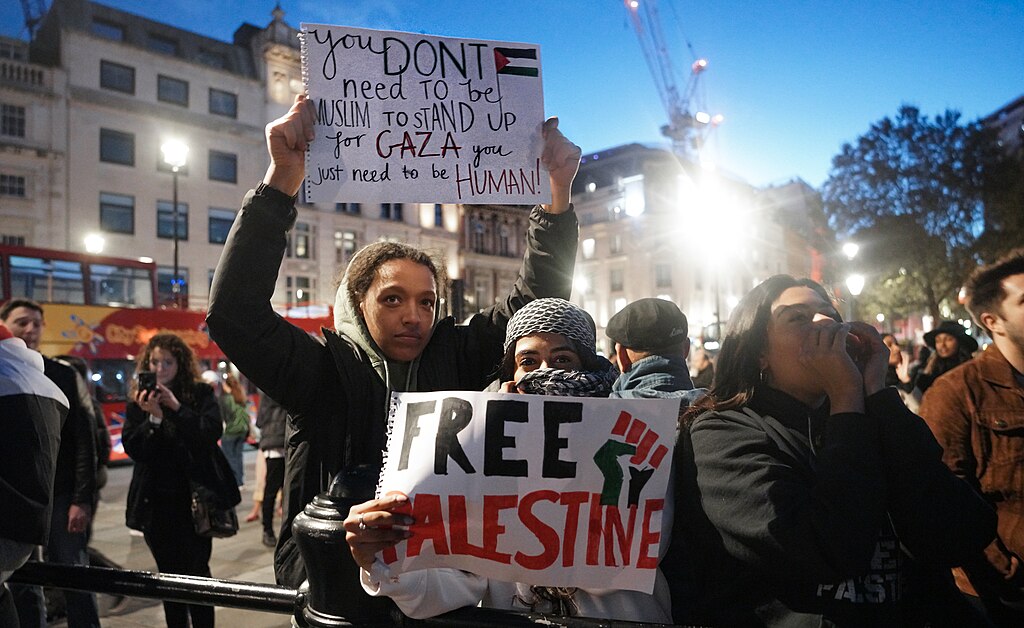
Pro-Palestinian demonstrators in London, Oct 14. WIKIMEDIA COMMONS
So what are the concerns that Arab states and the Gulf have to deal with when it comes to their policies on Gaza and Palestine? What kinds of considerations were driving their relationships with Israel pre-October 7, and how have things changed?
The Abraham Accords: an overview
Hailed as ‘The Deal of the Century’ by US President Donald Trump, in 2020 the UAE and Bahrain signed what became known as the Abraham Accords – bilateral agreements that normalised ties between the two countries and Israel, followed a little later by Morocco and Sudan. Because the Abraham Accords are a set of bilateral agreements, their content and details vary. But what is a common throughline between them is that they do not include Palestinians in the equation or discussions.
In 2022, over 66% of Emiratis disapproved of the Accords, as do 69% of Moroccans and 80% of Bahrainis.
Each country had its own reasons for signing up to the Accords, but they share one thing in common: they are deeply unpopular amongst the average person. In 2022, over 66% of Emiratis disapproved of the Accords, as do 69% of Moroccans and 80% of Bahrainis, strongly suggesting that there were more complex motives at play when it came to signing the them.
The UAE
The UAE has enjoyed close security and technological ties with Israel since at least 2009 when Gulf Cooperation Council countries started buying high-resolution imagery satellites and communication, homeland security, and civilian technology against terrorism from the country. Around the same time, the UAE and Israel began to see Obama’s nuclear deal with Iran as a shared existential threat. This sense of a shared vision only deepened when Israel, the UAE and Saudi Arabia were united in anger at Obama’s support for the overthrow of Hosni Mubarak’s government in Egypt, leading the Muslim Brotherhood to win elections in the country. This outrage was shared by Bahrain, which, like the UAE and Saudi Arabia, experienced significant unrest and popular mobilisation.
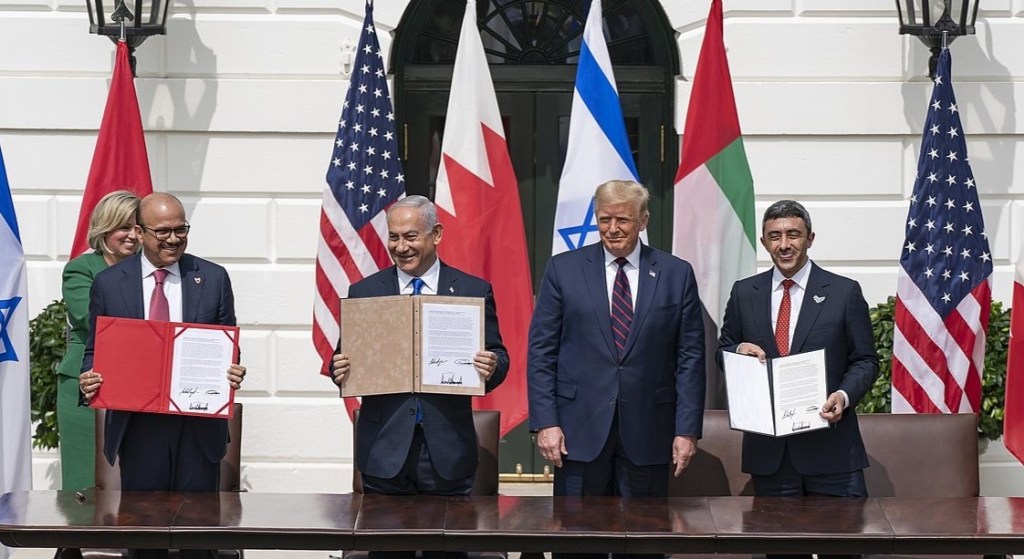
Trump, Netanyahu, and UAE and Bahrain Foreign Ministers Abdullah bin Zayed Al Nahyan and Dr. Abdullatif bin Rashid Al-Zayani sign the Abraham Accords. Sept. 15, 2020 WHITE HOUSE
United by a fear of nuclear Iran and what they see as Islamist populism in the region, defence cooperation increased. In the wake of the Arab Spring in 2011, the UAE secured an Israeli-installed mass surveillance system called ‘Falcon Eye’. A source close to the Falcon Eye project told Middle East Eye that as a result of the project, “every person is monitored from the moment they leave their doorstep to the moment they return to it. Their work, social and behavioural patterns are recorded, analysed and archived. It sounds like sci-fi but it is happening today in Abu Dhabi.”
United by a fear of nuclear Iran and what they see as Islamist populism in the region, defence cooperation between the UAE and Israel increased. In the wake of the Arab Spring in 2011, the UAE secured an Israeli-installed mass surveillance system.
According to a New York Times investigation, in 2010 Israel also provided the UAE with powerful spyware that could hack the phones of dissidents, foreign journalists, and foreign politicians as a peace offering after a diplomatic spat. Dubbed ‘Pegasus’ and created by the Israeli company NSO Group, the UAE used this spyware to target and imprison Emirati human rights defender Ahmed Mansoor. It was also used to target and detain British academic Matthew Hedges, who was detained for seven months and threatened with life in prison in 2018 until public pressure released him, and the spyware was found on the phone of human rights lawyer Rodney Dixon QC, who acted for both Hedges and the fiancée of the murdered Saudi journalist Jamal Khashoggi, Hatice Cengiz.
The above is an impartial list, but it shows how useful Israel has proven to the UAE and its ruler Mohammed bin Zayed in targeting domestic and foreign detractors and bolstering its technological capabilities. As a sweetener to normalisation with Israel, the US also promised the UAE a chance to buy F-35 fighters and advanced drones as part of a $23bn deal (historically, the US has resisted selling its most advanced weapons systems to Arab states to protect Israel’s military edge in the region – this and the UAE’s friendly relations with China has put the deal on hold at least for the time being).
Israel has proven itself useful to the UAE and its ruler Mohammed bin Zayed in targetting domestic and foreign detractors and bolstering its technological capabilities.
When the time came for the Abraham Accords, bin Zayed stated publicly that Israel had agreed to stop annexing further Palestinian territories. Netanyahu promptly contradicted him by stating that plans were only “temporarily suspended,” and that he was “still committed” to annexing parts of the West Bank. The Palestinian Authority responded with outrage and withdrew its ambassador to the UAE. Just a month before war returned to Gaza in October 2023, the UAE’s US ambassador Yousef Al Otaiba conceded that the Accords had failed to halt the Israeli annexation of Palestine.

A Palestinian man argues with Israeli soldiers during a protest in Nablus, West Bank. August 25, 2021. AP
Bahrain
Bahrain’s case is similar to the UAE’s: Bahrain was amongst the GCC countries that began to import Israeli technology in the 2000s, and it too gained access to the Pegasus spyware, which it used to target dissidents. When the Accords were being signed, Bahrain’s Interior Minister went as far as to state that normalization with Israel was also aimed at protecting Bahrain’s “internal security” from the ongoing “danger” of Iran in the region.
“Bahrain saw normalization as a way of strengthening its already close relations with the U.S., in order to bolster American support for Bahrain and deflect criticism of the kingdom’s human rights record.”
According to Yahya Alhadid, a Bahraini political activist and the president of the Gulf Institute for Democracy and Human Rights, “Bahrain saw normalization as a way of strengthening its already close relations with the U.S. and its position in Washington, especially among the pro-Israel community, in order to bolster American support for Bahrain and deflect criticism of the kingdom’s human rights record.”

Abdel Fattah Abdelrahman al Burhan, former Chair of Sudan’s Sovereignty Council. October 2019. WIKIMEDIA COMMONS
Sudan
Sudan, after a popular uprising in 2019 that forced out the country’s leader of nearly 30 years, Omar al-Bashir, was led by a Sovereignty Council (SC), a civilian-military partnership to steer the country towards democratic elections. Cash-strapped and in need of external support, the SC’s leader Abdel-Fattah al-Burhan joined the Accords after the US offered to remove Sudan from the US list of state sponsors of terrorism, enabling easier foreign investment and access to foreign capital. Negotiations on normalisation were held in the UAE, and the UAE has financially supported both al-Burhan and his ally-now-turned-rival, Hemedti. It is more than possible that Abu Dhabi helped broker the deal, as the UAE is concerned with containing any hint of political Islam and Muslim Brotherhood activity in the region.
When al-Burhan later on organised a coup to seize control from the civilian section of the Sovereignty Council, he explicitly evoked ties with Israel as a source of legitimacy to fight off calls for sanctions to be placed on Sudan.
When al-Burhan later organised a coup to seize control from the civilian section of the SC, he explicitly evoked ties with Israel as a source of legitimacy to fight off calls for sanctions to be placed on Sudan.
Morocco
As for Morocco, like Bahrain and the UAE, it is a kingdom where the greatest threats to the status quo are popular mobilisation and political Islamic sentiment. Like the two Gulf states, it also has deepened technological and security ties with Israel since the 2000s. It also shares with Israel the dubious honour of being a coloniser state, having occupied Western Sahara since 1975 and fighting a 16-year war with the Polisario Front, the native Sahrawis’ resistance organisation.

Bou Craa Phosphate Mine, Western Sahara. Phosphates are the main nutrient in agricultural fertiliser, and 70% of the world’s known reserves lie in Western Sahara.
The conflict ostensibly came to an end in 1991, when a UN-backed referendum on independence, integration, or autonomy was agreed upon. 32 years later, the referendum has yet to materialise, and Moroccan control, immigration, and economic exploitation of Western Sahara’s phosphate reserves and fishing stock has only intensified. According to Amnesty International’s latest report on Morocco and Western Sahara, “Torture and other ill-treatment continued with impunity both inside and out of prisons, particularly against Sahrawi activists.”
In the run-up to Morocco’s agreement with Israel, the Trump administration recognised Morocco’s sovereignty over Western Sahara. Three years after signing the Abraham Accords, Israel followed suit.
In the run-up to Morocco’s agreement with Israel, the Trump administration recognised Morocco’s sovereignty over Western Sahara. Three years after signing the Abraham Accords, Israel followed suit, and is considering opening a consulate in occupied Western Sahara. After all, in an era when calls to decolonise curricula are more common than calls to decolonise appropriated lands, birds of feather best flock together. The UAE and Bahrain have already recognised Morocco’s claims and opened consulates in occupied Western Sahara, as has Saudi Arabia. Morocco has also been a prolific user of the Israeli Pegasus spyware, going as far as to possibly hack French President Emmanuel Macron’s phone.
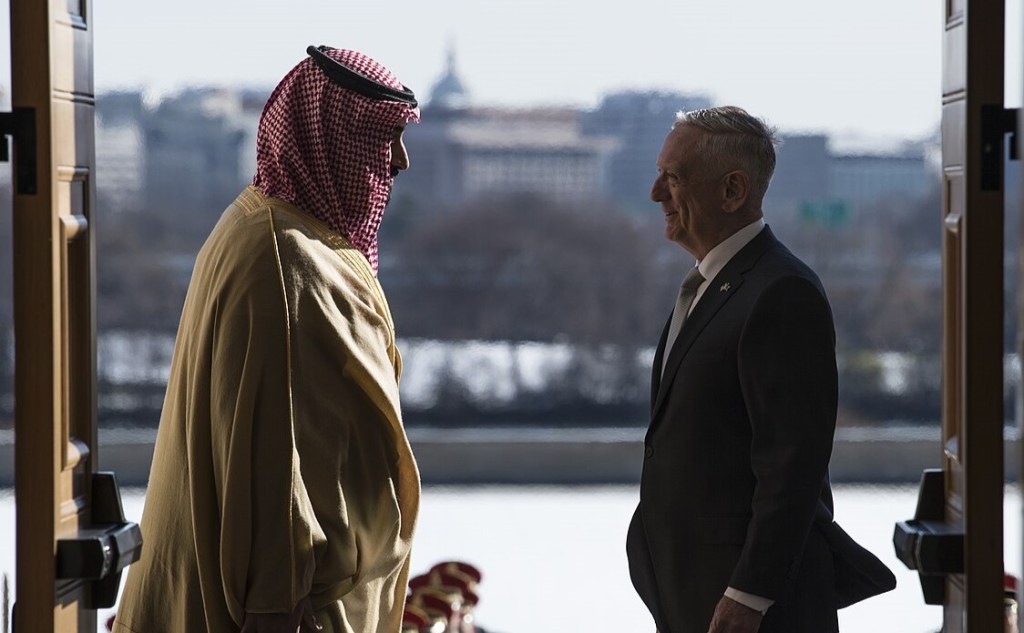
Saudi Crown Prince Mohammed bin Salman and then US Defence Secretary James Mattis, Mar. 22, 2018. WIKIMEDIA COMMONS/Kathryn E. Holm
Saudi Arabia
Though Saudi Arabia has not normalised relations with Israel, its ruler, Mohammed bin Salman, has seen the benefits normalisation has brought regional partners, and has sought to negotiate a deal for itself. According to Paul Salem of the Middle East Institute, the Saudis have two key items on their wishlist: 1) security guarantees from the US that it would come to the Kingdom’s defence in case of an external attack (the most likely aggressor being Iran), and 2) a civilian nuclear programme including 17 nuclear reactors and domestic enrichment capacities.
Though Saudi Arabia has not normalised relations with Israel, its ruler, Mohammed bin Salman, has seen the benefits normalisation has brought regional partners.
Neither being drawn into a conflict in the Persian Gulf nor a Saudi nuclear programme (which could enable military applications) are appealing to the Americans, but neither is losing a wealthy ally in the region or a Chinese or Russian-run Saudi nuclear programme. In either case, the negotiations have been halted for now.
Conclusions: what do regional motives bode for Palestine?
Looking at the landscape of relations between the Abraham Accord countries and Israel pre-October 7, it is clear that Arab states have been using normalisation as a way to coax concessions out of the US to bolster their own domestic and international security capabilities and legitimacy. This includes surveillance equipment, spyware, and weapons systems for Bahrain, the UAE, and Morocco. For Morocco, it includes US recognition of their occupation of Western Sahara, and Saudi Arabia is looking to gain similar concessions out of the US. For Sudan, the deal meant desperately needed investment opportunities and legitimacy for a newborn military dictatorship.
It is clear that Arab states have been using normalisation as a way to coax concessions out of the US to bolster their own domestic and international security capabilities and legitimacy.
What is most striking about these deals is that they adhere to the long-standing strategic and domestic interests of each country. Only the UAE put up the pretence of trying to seek concessions from Israel on the status of Palestine. One can only conclude that there is little appetite amongst the leaders of the region to find a sustainable solution to Israeli occupation or Palestinian rights. The Abraham Accords were built on the very premise that Palestinians do not matter in the political equation – what matters is Israel, the powerholder, with which the regional states could strike deals or leverage ones from the US. The Accords even signal that local popular opinion does not matter, as they are deeply disliked by the average person.

IDEX 2023: International Defence Exhibition & Conference 2023, held in Abu Dhabi.
Even beyond military deals, defence collaboration, investment opportunities, and US favour, perhaps the most significant incentive for these states to ignore the issue of Palestine is domestic: the greatest political threat to the rulers of the UAE, Morocco, Egypt, Bahrain, and Saudi Arabia comes from the Muslim Brotherhood and other Islamic-minded mass political movements. These forces demonstrated their potency during the Arab Spring in 2011, when the Muslim Brotherhood came to power in Egypt, street protests engulfed Bahrain and Saudi Arabia, and the UAE experienced its own surge in pro-democracy and Brotherhood activity (both movements were crushed quickly, but the agitation nonetheless spooked Emirati authorities since royals such as Sheikh Sultan bin Kayed al-Qassimi, cousin of the ruler of the Emirate of Ras al-Khaimah, were amongst the leadership of the local Brotherhood).
Historically, Palestine has formed the most potent rallying-cry for the Islamist movements of the region and is one of the few issues where rulers feel obliged to allow at least some form of public demonstration.
Most rulers in the region wish to create a world where pan-Islamic sentiment and Muslim Brotherhood agitation is no longer a political factor to be reckoned with and poses no threat to their authority. Historically, Palestine has formed the most potent rallying cry for the Islamist movements of the region and is one of the few issues where rulers feel obliged to allow at least some form of public demonstration. Removing Palestine from public discourse means weakening the legitimacy of Islamist talking points in the public sphere – or ‘narrowing the Overton window‘ to put things in more technical terms, and cementing the regional status quo. This is supported by the fact that signatories pushed on with the deals despite a lack of popular support for them.

People lining up to buy bread in Fustat, Cairo. May 2, 2022.
The one exception to this trend is Qatar, which continues to support Palestine and Islamist movements through financing and its Al Jazeera media conglomerate (although Al Jazeera English is relatively balanced on most topics, its Arabic-language counterpart is, in tone, more or less an Arabic version of Fox News with Islamist talking points and Palestine as daily features). Qatar has paid the price for this stance by suffering from a three-and-a-half-year blockade led by Saudi Arabia, the UAE, Bahrain and Egypt, which see Qatar’s political agitation as a threat.
“You want us to take one million people? Well, I am going to send them to Europe. You care about human rights so much – well, you take them.”
Egypt and Jordan have already signed peace deals with Israel in 1981 and 1994 respectively, and neither is in a position to act for Palestinians. Egypt is going through its worst economic crisis in living memory, and is dealing with a violent Islamic-State linked insurgency in the Sinai, right next to Gaza. Its prisons are bursting with political prisoners, and Gaza is becoming a rallying cry for popular sentiment against President al-Sisi: according to The Economist, “After Friday prayers on October 20th, chants of ‘Free Palestine’ morphed into cries for a ‘loaf of bread’”.
Rumoured Israeli plans to displace up to two million Gazans into the Sinai have understandably alarmed Egyptian officials. One angry senior Egyptian official at the Rafah border crossing to Gaza allegedly told a European official, not without merit: “You want us to take one million people? Well, I am going to send them to Europe. You care about human rights so much – well, you take them.”
“After Friday prayers on October 20th, chants of ‘Free Palestine’ morphed into cries for a ‘loaf of bread’”.
Jordan, like Egypt, is not economically secure. Around half of its population is of Palestinian origin, refugees and descendants of refugees from the 1948 Israel-Arab War. To summarise in the words of Ursula Lindsey, writing in the New York Review of Books: “[Jordan’s] monarchy stakes its legitimacy to a significant degree on representing the Palestinian people in the pursuit of a two-state solution. But it also views mobilization around Palestinian issues as a potential threat to its stability. Jordan almost had a civil war in 1970 when Palestinian militias based here tried to overthrow King Hussein.”
The unfortunate conclusion one has to draw when surveying the landscape of Arab-Israeli relations is that there is little incentive for Arab states to put pressure on the US to rein in Israeli aggression and war crimes. Although the Abraham Accords are unpopular, states that signed up to them have leveraged the deal to receive from Israel the very equipment they need to target and neutralise dissent. The same popular sentiment that drives the average citizen’s solidarity with Gaza is seen as a threat to the political order – and is therefore something to be controlled and eliminated, and this popular sentiment has already been ignored. But ironically enough, the systematic and gross violation of Palestinian rights is also a cause of this sentiment: to push for genuine accommodation in Palestine is to rid Islamist demagogues of one of their most popular talking points.
The US now faces a choice: whether it chooses to help build momentum for a solution that takes into account Palestinians and Muslim public opinion – or whether it continues down the road of driving a wedge between the rulers and ruled of one of the world’s most well-armed and volatile regions.
That being said, there is increasing pressure on Biden to somehow limit Israeli aggression and deliver some kind of semblance of peace. But what can be concluded with certainty is that the initiative will not come from Arab leaders, who have invested considerable time and political energy into trying to will into existence a world where Palestine does not matter. The Abraham Accords are the most conclusive proof of this, and the US has been the most important driver and enabler of this process. The US now faces a choice: whether it chooses to help build momentum for a solution that takes into account Palestinians and Muslim public opinion – or whether it continues down the road of driving a wedge between the rulers and ruled of one of the world’s most well-armed and volatile regions.
 Through the Seven Climes / Yedi İklim Boyunca
Leave a comment